The missing circuit element
Circuit theory is built on four quantities: voltage (v), current (i), charge (q) and magnetic flux (φ). The resistor relates voltage and current, the capacitor relates charge and voltage, and the inductor relates flux and current. In 1971, Leon Chua noticed that one pairing, between flux and charge, had no element of its own. He called the missing element the memristor, a contraction of memory resistor.
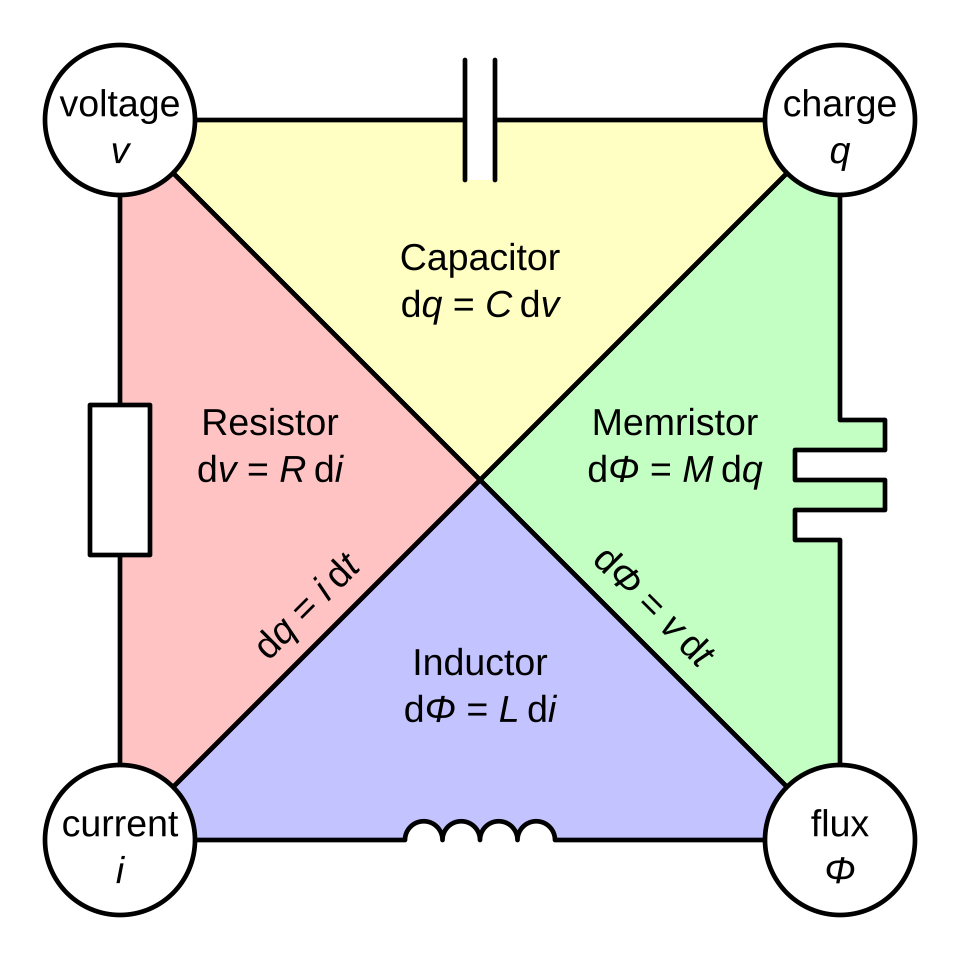

A memristor behaves like a resistor whose value depends on the history of the current that has flowed through it. When the power is removed, it keeps its state: it remembers. In 1976, Chua and Kang generalised the idea to memristive systems, a broader family of devices with this kind of state-dependent behaviour.
From theory to real devices
For decades the memristor was mostly a theoretical curiosity. In 2008, a team at HP Labs connected Chua’s theory to a thin-film titanium-dioxide device: moving oxygen vacancies changed the boundary between a resistive TiO₂ layer and a conductive, oxygen-deficient TiO₂₋ₓ layer, and therefore the total resistance.
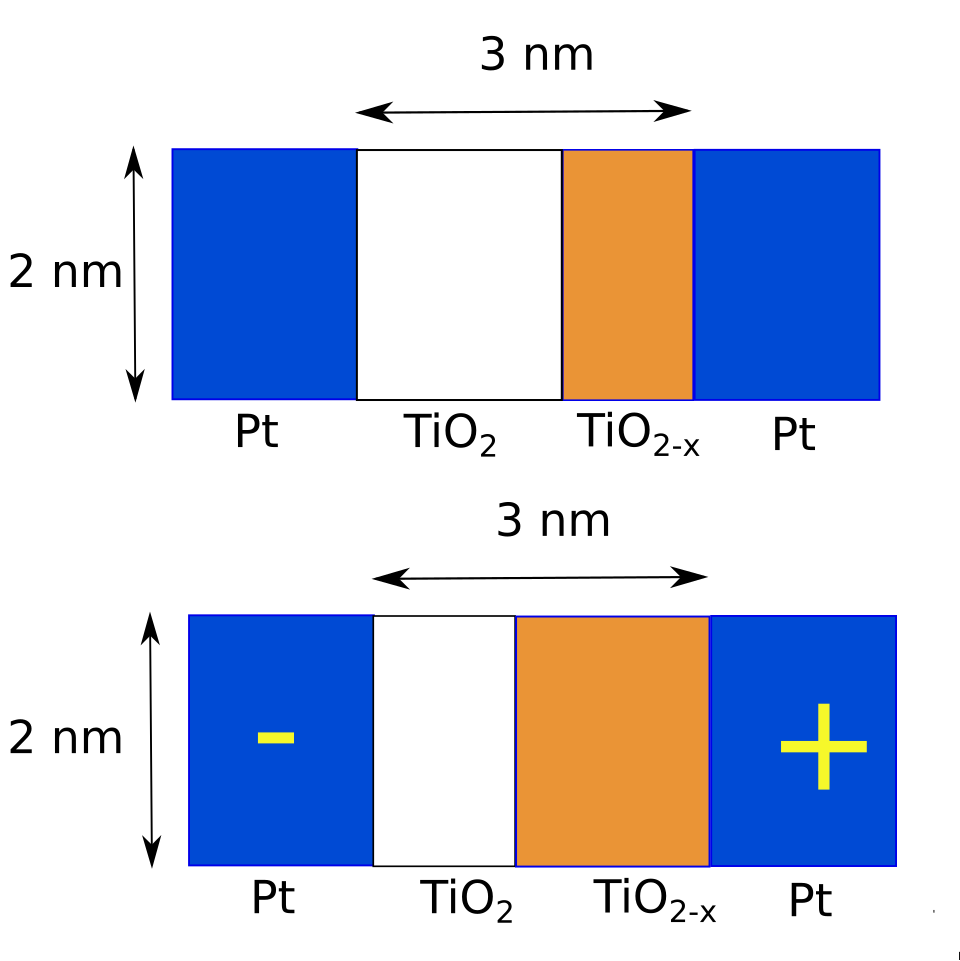

Today the term covers many resistive switching technologies, also known as RRAM or ReRAM. In valence change memories (VCM), oxygen vacancies form and dissolve conductive paths in an oxide such as HfO₂, TiO₂ or Al₂O₃. In electrochemical metallization cells (ECM or CBRAM), metal ions such as silver or copper do the job. Phase-change, ferroelectric, two-dimensional and organic materials broaden the field further, and several of them are studied within MemFRAME.
How resistive switching works
A typical device is a metal–insulator–metal sandwich only a few nanometres thick. Applying a voltage moves ions or defects inside the insulator:
- Forming. A first, higher-voltage step creates a conductive filament in the pristine insulator.
- SET. The filament is (re)built and the device switches to its low resistance state (LRS). A current limit, the compliance, prevents damage.
- RESET. The filament is partially dissolved and the device returns to its high resistance state (HRS).
- Analogue states. Carefully controlled pulses can set many intermediate resistance levels, which is key for neuromorphic applications.
In bipolar devices SET and RESET need opposite voltage polarities; in unipolar devices the same polarity with different amplitudes is enough.
The fingerprint: pinched hysteresis
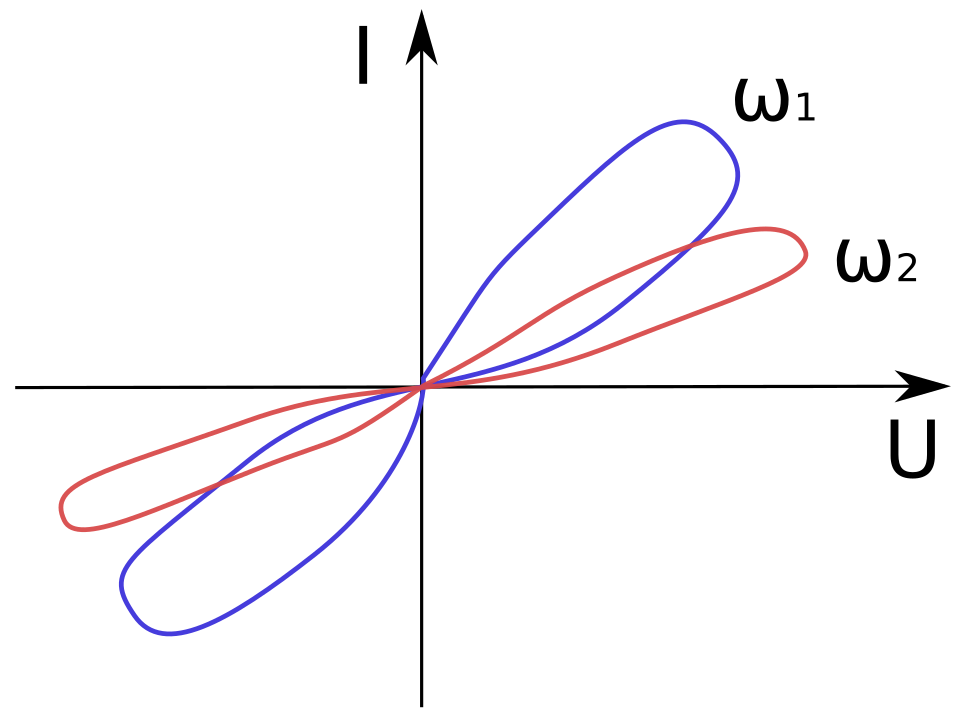
Drive a memristor with a sinusoidal voltage and plot current against voltage: you get a loop that always passes through the origin, because there is no current without voltage. This pinched hysteresis loop is the memristor’s fingerprint. As the frequency increases, the internal state has less time to change and the loop shrinks towards a straight line.

Why memristors matter
- Non-volatile memory. Fast, low-power, scalable storage that keeps data without power and can be stacked in dense 3D crossbar arrays.
- In-memory computing. In a crossbar, Ohm’s law multiplies and Kirchhoff’s current law adds: a whole vector–matrix multiplication, the core of neural networks, happens in one step, where the data is stored.
- Neuromorphic hardware. Memristors can emulate synapses, strengthening or weakening with activity and even reproducing spike-timing-dependent plasticity.
- Hardware security. Their intrinsic randomness makes good physical unclonable functions (PUFs) and random-number generators. What are PUFs?
- Nonlinear circuits. Oscillators, chaotic circuits and analogue signal processing. What is nonlinear electronics?
Open challenges
Switching is driven by the movement of a few atoms, so devices vary from cycle to cycle and from device to device. Endurance, retention, scaling and integration with CMOS still need work, and circuit designers need reliable compact models and design kits. These are exactly the problems that MemFRAME tackles, from materials to an open PDK.
Glossary
- HRS / LRS
- High and low resistance states of a resistive switching device.
- SET / RESET
- Transitions to the low and to the high resistance state, respectively.
- Forming
- Initial operation that creates the first conductive filament in a fresh device.
- Compliance current
- Current limit applied during SET to avoid irreversible breakdown.
- VCM / ECM
- Valence change memory (oxygen-vacancy based) and electrochemical metallization memory (metal-ion based).
- Crossbar array
- Grid of perpendicular electrodes with a memristor at every crossing point.
- Compact model
- Set of equations that describes a device accurately and quickly enough for circuit simulators such as SPICE.
- PDK
- Process Design Kit: models, layers, design rules and layouts that let designers create circuits for a given technology.
Want to go deeper? See Further reading.