At a glance
| Full title | Development of an Integrated Research Framework for Memristive Devices: Linking Materials, Physical Mechanisms and Predictive Modeling |
|---|---|
| Acronym | MemFRAME |
| Reference | PID2025-170062NB |
| Type | Coordinated project, four research groups |
| Duration | 1 September 2026 to 31 August 2029 (36 months) |
| Coordinator | Universidad de Granada |
| Partners | Universidad de Valladolid · IMB-CNM-CSIC · Universitat Autònoma de Barcelona & Universitat de les Illes Balears |
| Funding | MICIU/AEI/10.13039/501100011033 and ERDF/EU |
Summary
This project aims to develop an integrated research framework for the analysis, modelling and physical understanding of devices and circuits based on memristor technologies. Its general objectives also encompass the transversal fields of advanced materials, micro- and nanoelectronics, and artificial intelligence (AI). By overcoming the limitations of CMOS scaling, memristor devices are expected, in the near future, to pave the way toward accelerated AI, edge computing and neuromorphic architectures. Achieving these breakthroughs, however, requires a strong multidisciplinary effort that integrates materials science, device physics, and circuit design and implementation. To meet this challenge, the expertise of four leading research groups is brought together to undertake a comprehensive, ambitious, yet realistic project.
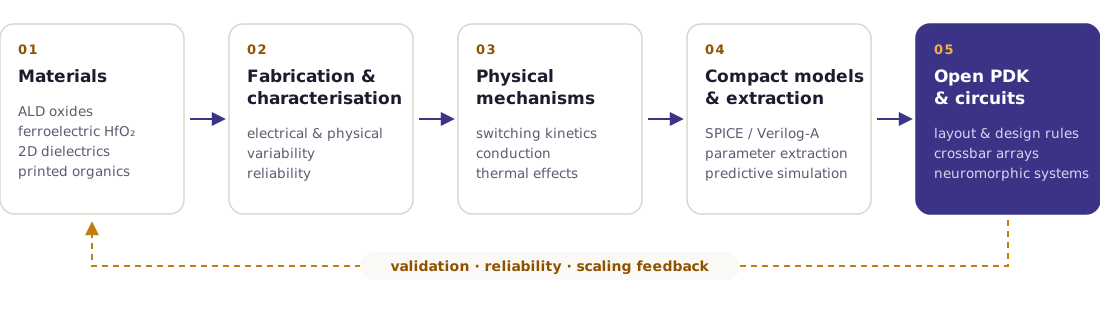
Within this collaborative effort, the project builds on a reliable ALD-based oxide memristor technology that serves as a core technological reference. The consortium then broadens its materials scope to ferroelectric hafnia films, 2D dielectrics, and solution-processed or printed organics. Through complementary strengths in fabrication, characterisation and modelling, all partners deepen the understanding of memristive behaviour and contribute to a unified predictive framework for device and circuit performance.
The next step toward enabling circuit-level use, whether for academic or industrial purposes, is the development of a Process Design Kit (PDK) and its deployment within an open collaboration framework capable of addressing areas that exceed current capabilities. To reach this objective, fully functional compact models and well-established parameter-extraction routines are essential. In parallel, further technological validation, including the integration of multiple devices, reliability studies, scaling and crossbar-array implementations, requires advanced characterisation techniques and simulation tools.
Research framework
Objectives
- Consolidate a reliable ALD-based oxide memristor technology as the consortium’s common technological reference.
- Broaden the materials scope to ferroelectric hafnia films, 2D dielectrics and solution-processed or printed organics, including flexible substrates and unconventional device structures.
- Deepen the physical understanding of memristive behaviour through complementary fabrication, characterisation and modelling.
- Develop compact models and parameter-extraction routines within a unified, predictive framework for device and circuit performance.
- Advance technological validation: integration of multiple devices, reliability, scaling and crossbar-array implementations.
- Create a Process Design Kit (PDK) for memristive devices and deploy it within an open collaboration framework.
Expected impact
A PDK for memristive devices is crucial for the Spanish semiconductor industry: it accelerates innovation and leverages nationally developed technology in emerging device solutions, including non-volatile memories and neuromorphic systems. The fabrication and characterisation expertise gained across different materials and processes, together with the modelling and simulation tools developed by the consortium, will also benefit other memristive technologies, such as organic, flexible or unconventional devices.
Building on experience. MemFRAME continues the collaboration established in three previous coordinated projects, most recently NeMeSys (PID2022-139586NB).