Coordinated research project · 2026–2029
An integrated framework for memristive devices
MemFRAME links materials, physical mechanisms and predictive modelling, from atomic-layer-deposited oxides to an open Process Design Kit for memristive circuits.
4research groups
5universities and research centres
36months, September 2026 to August 2029
1,000+publications by the team
Why MemFRAME
Beyond CMOS scaling, towards brain-inspired hardware
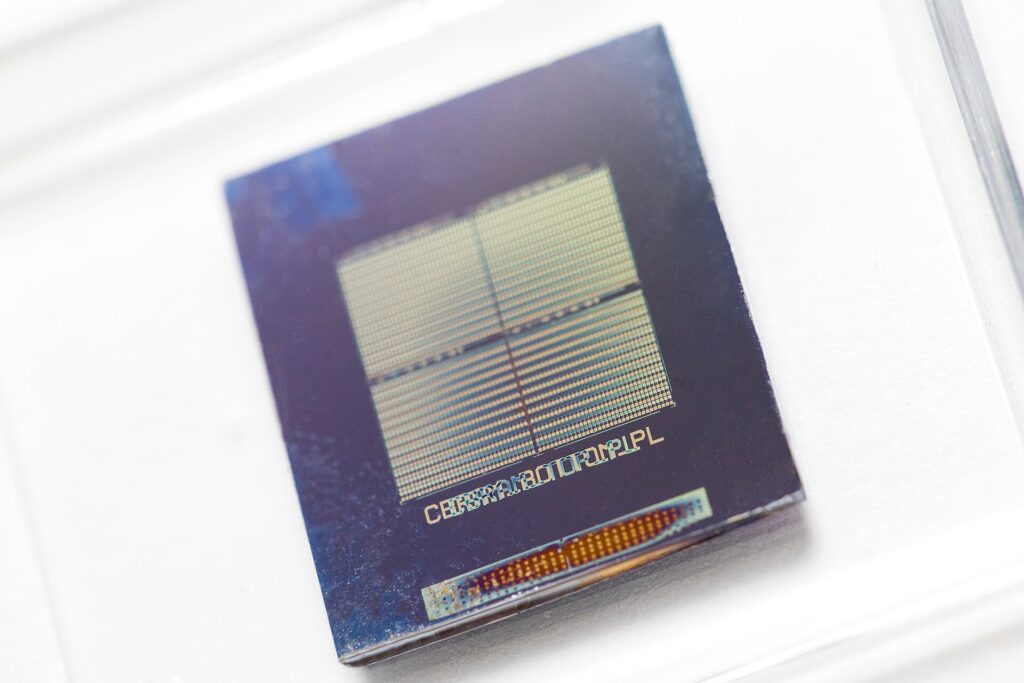
Memristors are two-terminal devices whose resistance depends on their electrical history. By overcoming the limitations of CMOS scaling, they are expected to pave the way toward accelerated artificial intelligence, edge computing and neuromorphic architectures.
Achieving these breakthroughs requires a strong multidisciplinary effort that integrates materials science, device physics, and circuit design and implementation. MemFRAME brings together four Spanish research groups, building on the synergies of three previous coordinated projects, to create a unified, predictive framework for memristive devices and circuits.
Research lines
Four pillars, one framework

01
Materials
A reliable ALD-based oxide technology as the core reference, broadened to ferroelectric hafnia, 2D dielectrics and solution-processed or printed organics.

02
Physical mechanisms
Complementary fabrication and characterisation to understand switching, conduction, variability, reliability and scaling.

03
Predictive models
Fully functional compact models and well-established parameter-extraction routines that link device physics to circuit simulation.

04
Open PDK
A Process Design Kit for memristive devices, deployed in an open collaboration framework for academic and industrial circuit design.
Consortium
Four groups, complementary expertise
Fabrication, characterisation, modelling and circuit design, interwoven across five institutions.
Universidad de Granada Coordinator
J. B. Roldán · F. Jiménez-Molinos
Compact modelling & simulation
Compact, semi-empirical and thermal models of resistive switching devices for circuit simulation.
Universidad de Valladolid
H. Castán · S. Dueñas
Electrical characterisation
Advanced electrical characterisation of high-k dielectrics and resistive switching devices.
IMB-CNM-CSIC
M. Bargalló González · C. Martínez-Domingo
Memristor technology
Design, fabrication and characterisation of high-k and printed memristors, from single devices to crossbar arrays.
UAB · UIB
E. Miranda · R. Picos
Modelling, circuits & open tools
Memdiode compact models, circuit-level design and open-source PDK tools.
Publications
Latest from the consortium
Loading publications…
Education & outreach
Learn about memristors
Introductory material, open design kits and even a Minecraft mod to explore memristive circuits, for students, teachers and the curious.
Introduction to memristors
What they are, how they switch and why they matter.
Open PDKs
openMemristorPDK and openPDKcreator: free design kits and tools.
CircuitSimCraft
A Minecraft mod that turns the game into an analogue electronics lab, memristors included.
Further reading
Classic papers and reviews to go deeper.

Funding. MemFRAME, project PID2025-170062NB, is funded by MICIU/AEI/10.13039/501100011033 and by ERDF/EU.